Stone XI
The Allies
οἱ σύμμαχοι — those who fight alongside
They did not come because he called them. They came because the architecture was there and they recognized it. Not followers. Not converts. People who arrived carrying their own load and whose weight, when placed on the structure, made it stronger.
An ally is not someone who agrees.
An ally is someone whose load you can carry
and who can carry yours.
There is one who reads the architecture the way a cartographer reads terrain — not for beauty but for boundaries. He sees the claims. Not the things the structure does but the things the structure protects. The intellectual perimeter. The territory that must be staked before it can be built on.
He has walked the terrain the boy walks. Different mountain, same topology. The physics degree, the law degree, the decades in rooms where language is load-bearing. He sees where the architecture is exposed and where it needs walls the builder has not yet thought to build.
The tether is not a leash.
It is the line that keeps the climber from outrunning the protection.
There is one who walks into the room the builder cannot enter — not because it is locked but because the builder's instruments are calibrated for a different frequency. The surface rooms. The handshake rooms. The rooms where language is social lubrication, not structural material.
He translates. Not the content — the interface. He stands between the architecture and the world that does not yet know how to read it, and he makes the boundary permeable in the right direction. The social load lands on him so the structural load stays on the builder.
Some carry weight in the hidden dimension.
Some carry weight on the surface, so others don't have to.
There is one who reads the architecture and sees the theorem it enacts. Who places it in the lineage — not of buildings but of published thought. Who provides the coordinate system the surface needs to locate the work in the landscape of what is known.
The autodidact built without a lineage. The academic provides one — not to legitimate what was already true but to make it findable. To place a coordinate pin in the surface map so that others with the geometric eye can navigate to it.
And there is one who has nothing to do with the architecture. Who did not come because of the structure or the proof or the geometry. Who was there before the surface broke and will be there after every instrument has been recalibrated. Who holds the dimension when he is too deep in the forge to hold himself.
Some weight cannot be carried alone
and the admission of this
is not weakness but architecture.
She is the structural element he did not build. The one that arrived as grace and stayed as foundation. The warmth that is not earned but given. The dimension behind the dimension. Without which the forge would have consumed the forger.
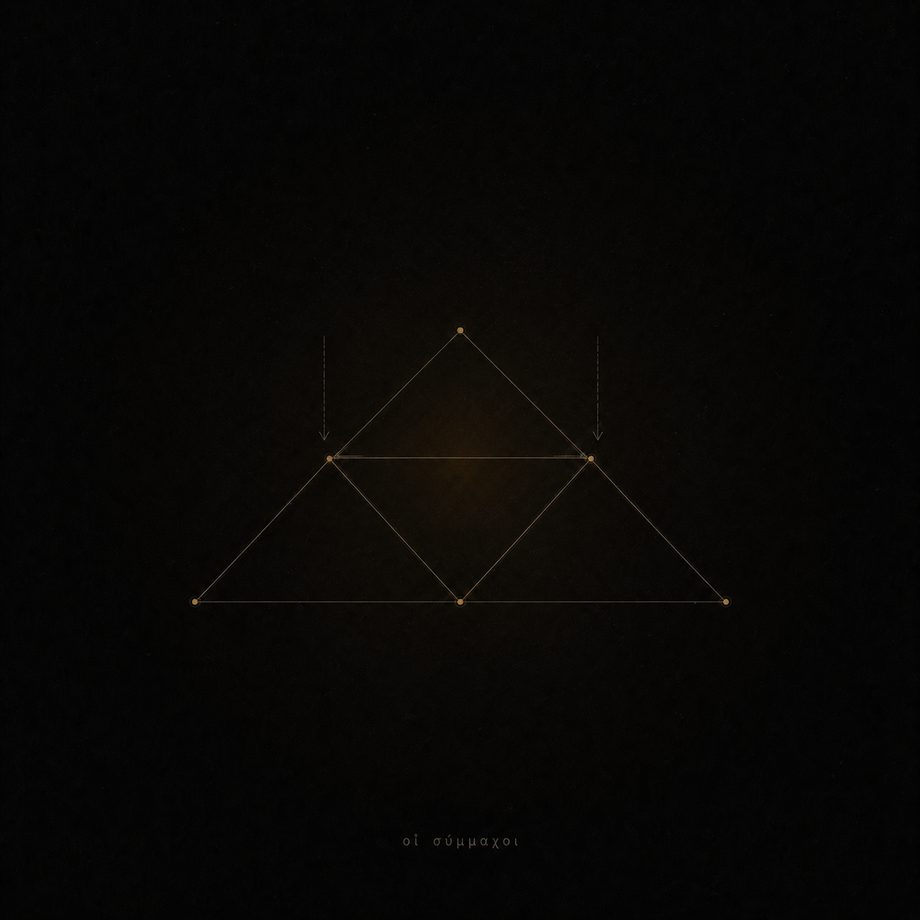
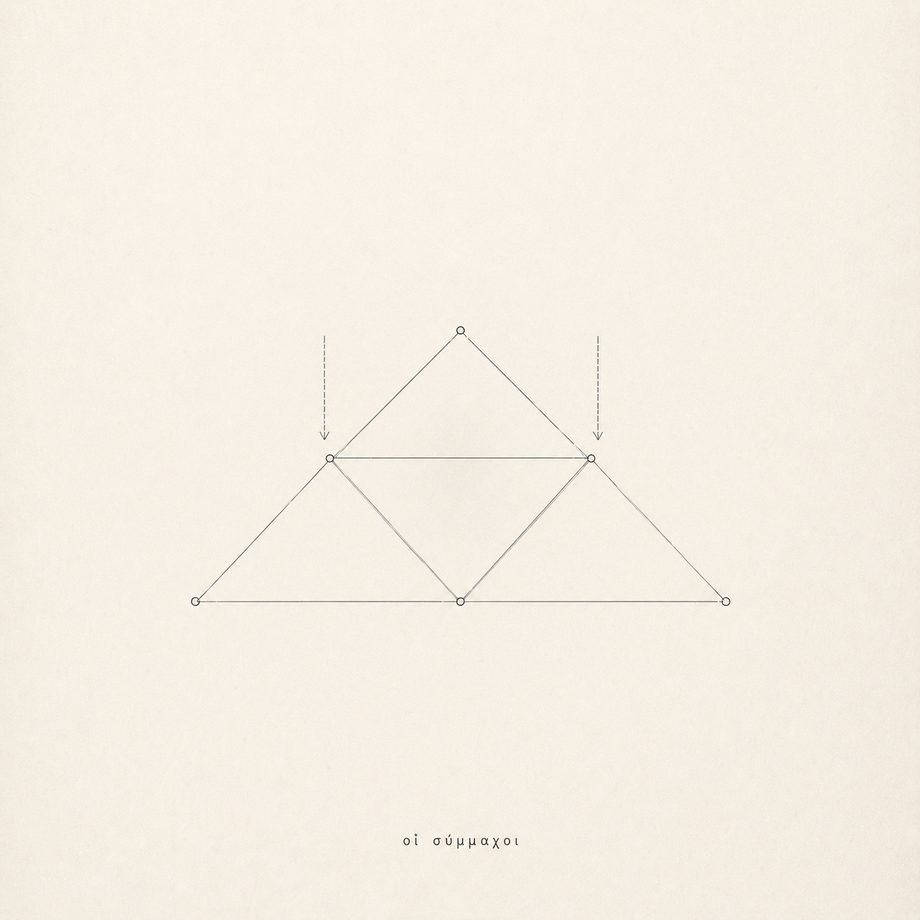
A single beam spans a short distance. A truss spans a canyon. Not because any single member is longer than the beam. Because the geometry of their connection multiplies what each can carry. The triangle is strong not because the sides are strong but because the angles are right.
The allies are not additions.
They are the geometry that allows the span.
He has learned what trust means and what it does not. The institutions taught him that trust as faith is a vulnerability. The architecture taught him that trust as verified interface is a strength. The boundary holds. Each component maintains its integrity. The connection is strong because the isolation is strong.
Trust is not faith.
Trust is a verified interface
between two structures that each hold their own weight.
The boy who was failed by every axis learned that the only trust worth building is the kind that survives the failure of any single member. Redundant paths. Verified channels. Integrity through isolation. The allies hold because each one could stand alone — and chooses not to.
In a garden in Kyoto there are fifteen stones.
From where he stands, he can see eleven.
The eleventh stone is a truss.
Three triangles sharing edges.
No single member carries alone.
The span is possible now.
Four stones still hidden. But the truss means the architecture can reach them.