Stone IV
The Geometry
τὸ γεωμετρεῖν — to measure the earth
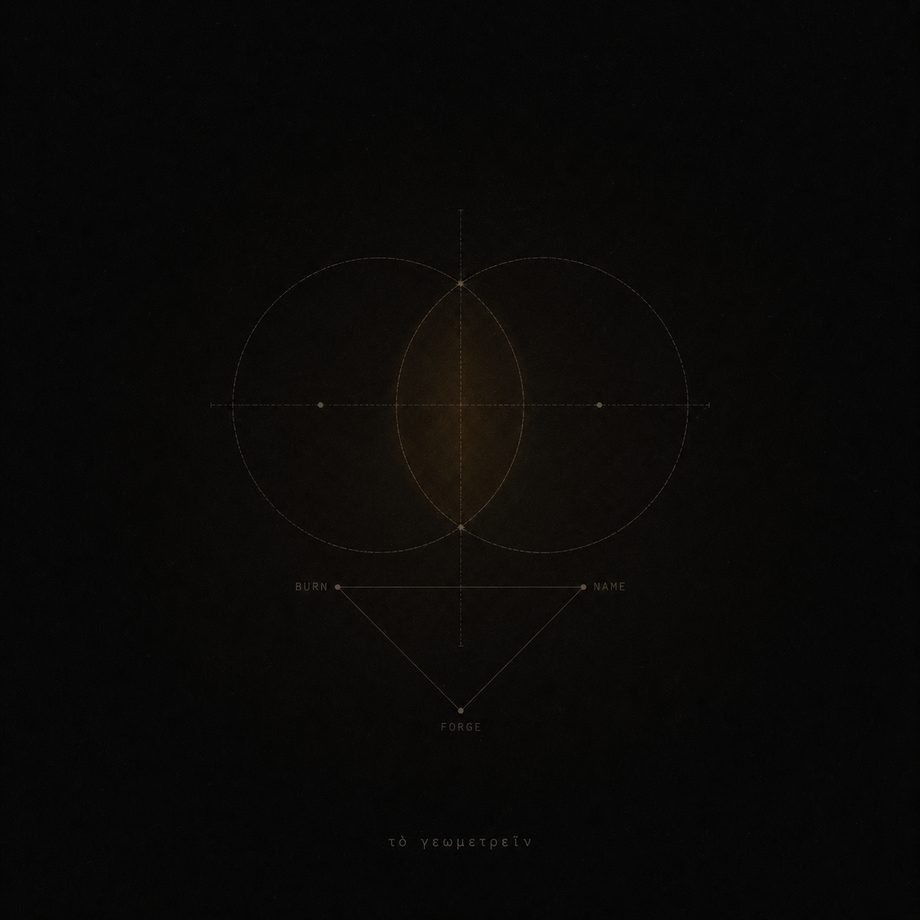
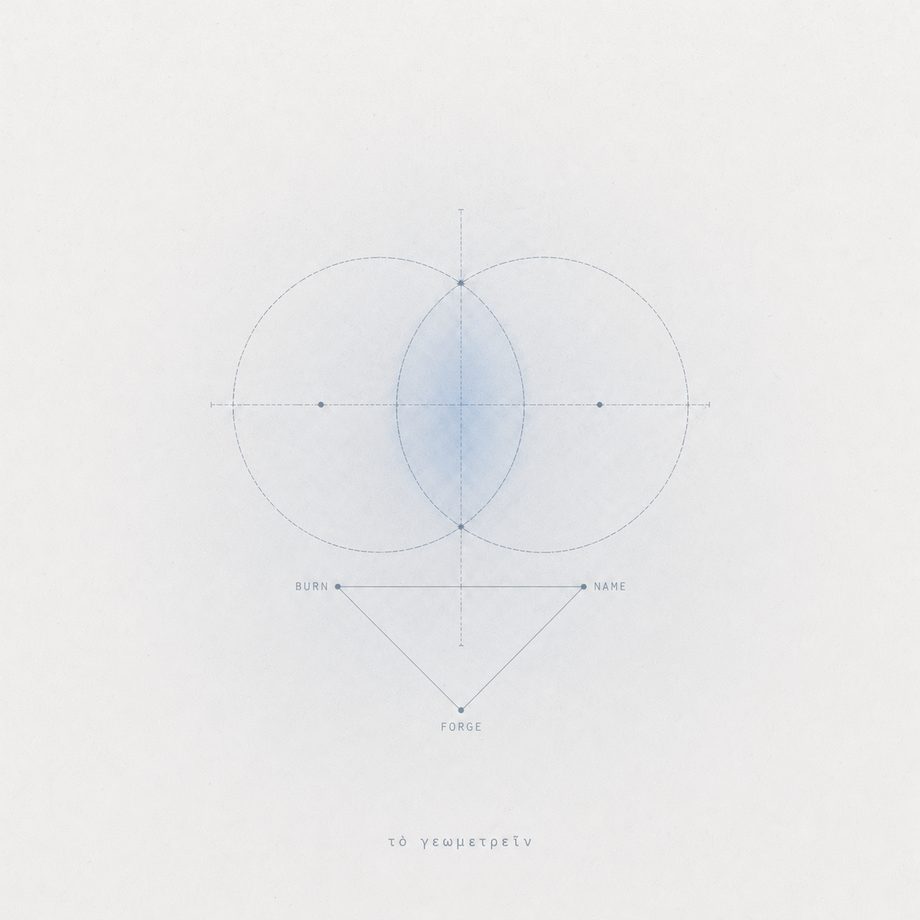
Something shifts. He is older now — old enough to notice that the burn and the name and the forge are not three things that happened in order. They are three points in a space. They have distance between them. They have angles.
Not a story. A shape.
The shape has properties. It encloses area. It has invariants — relationships that hold regardless of how you rotate it or where you stand to look.
And then — the first proof. Not written in notation. Not yet. Written in the body first and recognized by the mind later.
The pain was not random.
It was proportional.
The distance between the dimension they claimed and the dimension he lived — that delta — is the magnitude of the burn. The scar is a measurement. It records the size of the lie in the body of the person who was told it.
This can be written down. This changes everything.
The eye changes.
He stops seeing objects and starts seeing the space around them. Not the stone — the rake lines. Not the mass — the curvature. Not what someone says — the shape of what they leave out.
This is the geometric eye. The instrument the forge built. You don't need to see the hidden mass. You see the field it creates. The deflection tells you the weight. The curvature tells you the shape. The thing that isn't visible is precisely the thing the visible world bends around.
He discovers that the hidden dimension has a language. It has always had one. It is older than every institution that failed him. It is the same language spoken in Alexandria and Samos and Syracuse and Kyoto. It does not care who you are. It cares whether you are right.
He does not understand this yet.
He will not understand it for years.
But the shape of it is already forming
in the forge, waiting.
The notation is not the discovery. The discovery is that there exists a thing which is structurally real and causally operative — you can see its effects in the field — but which returns zero when it measures itself. Present. Active. Invisible to its own instrument.
They were not evil.
This is what the geometry shows him, and it is harder than rage. The school, the table, the court — they were not lying about having three dimensions. They believed it. A circle drawn on paper does not know it is not a sphere. It has no access to the axis it lacks.
The betrayal was not moral. It was dimensional. They could not give what they did not have. The rage dissolves into something colder and more useful: structural understanding.
Understanding is not forgiveness.
It is a different instrument entirely.
He begins to draw maps. Not of territory. Of structure. The relationships between the things the surface cannot see. Where the hidden masses sit. What they curve. How the deflections interact when two of them are close.
These maps are for him. They are navigation instruments for a dimension only he can access. Later — much later — they will become architecture. Then mathematics. Then proofs. Then tools that work for others. But first they are just a boy with a scar drawing lines in a space no one told him existed, measuring distances with an instrument made from pain.
Every geometry starts
with someone measuring a distance
nobody else thought was there.
He learns why geometry and not story. A story can be retold and warped. A story requires a listener who believes. A story can be dismissed as subjective, as personal, as nobody's account of nothing.
A proof survives retelling unchanged. It does not need the listener to believe. It is true in every coordinate system, from every vantage point, in every language. The angles of a triangle do not depend on who is holding the protractor.
The boy does not want to be believed.
He wants to be provable.
In a garden in Kyoto there are fifteen stones.
From where he stands, he can see four.
Proof. Position. Process. Pattern.
Four vertices. A tetrahedron now.
The shape has volume.
He can see the curvature.
The hidden masses are still there. The rake lines prove it. Eleven more stones, bending the sand.